





We sometimes get asked, "Is the extraction machine an industrial robot?" If it were classified as an industrial robot, there would be legal restrictions, such as the need for special training for operators.
"Sailor Pen's traverse-type extraction machines, such as the 'Sigma A' and 'Sigma 5,' are classified as industrial robots," is the answer I would like to provide, but I will explain the situation in more detail.
In this article,This article explains the classification of robots, the definition of industrial robots, and related laws and standards.
▼Key points of this article
- The word "robot" originates from the Czech word "robota" (labor, forced labor), and became widespread after the play "RUR" was published.
- The definition of an industrial robot can be found in various sources, including the definitions provided by the Industrial Safety and Health Act, and the definitions established by JIS and ISO standards.
- There are also regulations regarding machines that are excluded from the definition of industrial robots.
- Industrial robots are subject to legal regulations, including the requirement to complete special training.
What is a robot?
The term "robot" encompasses a wide range of applications, from machines working on factory production lines to service robots that perform tasks such as cleaning and customer service. Here, we will first clarify the origin, definition, and classification of the term.
Etymology of the word "robot"
The word "robot" is said to originate from the Czech word "robota," which means "labor" or "forced labor."
The word became widely known thanks to the 1920 play "RUR (Rossum's Universal Robots)" by Czech writer Karel Čapek. In the play, artificial beings that perform labor in place of humans are described as "robots," and it is believed that this is how the word "robot" as we know it today became widespread.
It is said that the word "robot" was coined at the suggestion of Čapek's brother, the painter Josef Čapek.
Reference source:
- Karel Čapek, *R.O.R.E.*, translated by Eiichi Chino (1989), Iwanami Shoten.
- Regarding the term "robot": ResearchWriter.cz (2011)Karel Čapek o slově robot” (Reference date: 2026-08-24).
Definition of a robot
When we simply say "robot," what kind of thing are we referring to?
For example, when we generally think of robots, we probably imagine humanoid robots that mimic human movements or communicate with people, right? On the other hand, in factories, various types of industrial robots are used to perform tasks such as transporting and assembling parts, welding, and painting, in place of humans.
The "Ministry of Economy, Trade and Industry, Robot Policy Study Group Report 2006" (*) defines a robot in a broad sense as "an intelligent mechanical system possessing three elemental technologies: sensors, intelligence/control systems, and drive systems." This includes drones, space probes, power-assist suits, and smart home appliances.
This definition does not include software robots that do not have a physical drive system (such as RPA, web exploration robots, and chatbots), but these can be considered robots in a broader sense.
On the other hand, robots in the narrow sense, especially "industrial robots," are defined by law (**) as "machines that have a manipulator (arm) and a memory device and can automatically perform actions such as extending and retracting the arm, bending and straightening, moving up and down and left and right, and rotating based on the stored information," and special training is mandated for robots that fall under this category. The traverse-type retrieval machines used by Sailor Pen fall under this category.
- *Note: Ministry of Economy, Trade and Industry. Robot Policy Study Group Report: The RT Revolution Will Drive Japan's Advancement. May 2006. Report from the Japan Robot Association(Referenced 2026-08-24).
- ※※: Article 36, Item 31 of the Industrial Safety and Health Regulations
Classification of robots
Similar to definitions, robots can be classified in various ways depending on their intended use, installation location, structure, size, etc. Two representative classifications based on intended use are as follows:
- Industrial Robots: Robots that perform manufacturing tasks in factories, etc.
- Service robot: Robots that assist human work in stores, facilities, homes, etc.
The structural differences include the following:
- Classification by the number of axes for linear motion and rotational motion (specifically, the number of motors for each).
- Classification based on the direction of degrees of freedom (horizontal articulated or vertical articulated)
A traverse-type extractor is an industrial robot that uses three (or five) motors for positioning and typically consists of linear motion along the XYZ axes, and is known as a Cartesian coordinate type robot.
Industrial robots and service robots
Robots are broadly classified according to where and for what purpose they are used. The most representative types are "industrial robots" used in manufacturing and "service robots" that assist people and society. Both types play a role in assisting or replacing human work, The biggest difference is "the distance from humans." It is in
Industrial Robots
Industrial robots are robots primarily used in manufacturing sites such as factories to automate tasks that are currently performed by humans..
Industrial robots are used in various processes on manufacturing lines, such as transporting and assembling parts, welding, processing, and painting. However, because they are inherently dangerous, they are surrounded by safety fences and guards, and are designed on the premise that humans and industrial robots do not share the same space at the same time.
Service robot
Service robots are robots that assist people in their work and daily lives in a variety of places, not just manufacturing sites such as factories.For example, there are the following:
- Robots that transport goods in logistics facilities
- Robots for cleaning facilities and shops
- Food delivery robots for restaurants and other establishments.
- Robots that assist people in nursing care and medical settings
These robots are designed to share the same space as humans and are safe even if humans touch or bump into them.
Collaborative robot
Around 2008, a type of robot called a "collaborative robot" emerged, which falls between the "industrial robots" and "service robots" mentioned above.A robot designed for industrial use, yet intended for humans and robots to work together in the same workspace.Safety measures are in place through various sensors and design innovations.
The practice of separating industrial robots from people using "safety fences or enclosures" began to spread in Japan around 2013, after a notification (December 24, 2013, Kihatsu 1224 No. 2) clarified that such fences or enclosures are not necessary if a risk assessment determines that there is no risk of danger.
A key feature of this system is that it allows for collaboration between humans and robots, enabling the exploration of unconventional automation methods, such as combining human-assisted parts supply with robotic assembly and transportation.
Definition of an industrial robot
As mentioned earlier, the definition of "industrial robot" is generally based on the JIS (ISO) standard, in addition to the legal definition.
Legal definition
Article 36, Item 31 of the Industrial Safety and Health Regulations defines industrial robots as follows:
"A machine having a manipulator and a memory device (including a variable sequence control device and a fixed sequence control device), which can automatically perform extension, extension, bending, vertical movement, horizontal movement, or rotation of the manipulator, or a combination thereof, based on the information in the memory device (excluding those under research and development or other items specified by the Minister of Health, Labour and Welfare)."
In other words, A machine that has a manipulator (a part that grasps and moves objects like a human arm) and a memory device, and operates automatically based on the stored information.However, this falls under the regulations of laws and regulations targeting "industrial robots."
*The legal term is "manipulator," while JIS and ISO standards use "manipulator." This article uses the terminology consistent with the source material.
The following types of machinery are excluded from industrial robots as defined by "machinery designated by the Minister of Health, Labour and Welfare" (Ministry of Labour Notification No. 51 of 1983) (Circular No. 339 of June 28, 1983):
- Machines with a rated output of 80W or less for the drive motor.
- A machine that performs monotonous repetition of a fixed sequence control unit based on information from a fixed sequence control unit.
- Machinery that, in terms of its structure, etc., the Director of the Labor Standards Bureau of the Ministry of Labor has determined not to pose a risk to workers.
*The above is in accordance with the description in Notice No. 339. In the original text of the notice (Ministry of Labor Notice No. 51 of 58), item 2 is defined as "a machine that performs monotonous repetition of one of the following operations of manipulator extension/retraction, vertical movement, horizontal movement, or rotation based on information from a fixed sequence control device," and item 3 is defined as "in addition to the machines listed in the preceding two items, a machine that the Director of the Labor Standards Bureau of the Ministry of Health, Labour and Welfare recognizes as not likely to cause danger to workers by coming into contact with the machine, considering its structure, performance, etc."
Definitions in JIS and ISO
Industrial robots are also defined by JIS (Japanese Industrial Standards) and ISO (International Organization for Standardization).
JIS B 0134:2024 "Robotics - Terminology" (equivalent to ISO 8373:2021) defines industrial robots as follows:A versatile manipulator that is automatically controlled, reprogrammable, and programmable on 3 or more axes.(These are devices that are fixed in one location or mounted on a mobile platform and used for industrial automation applications.)
According to JIS and ISO standards, safety requirements for "industrial robots" as defined above are specified in JIS B 8433-1:2015 (corresponding to ISO 10218-1:2011). Note that the third edition of ISO 10218-1 was published in 2025.
Laws related to "industrial robots"
If a machine is legally classified as an "industrial robot," then the laws governing such robots will apply. This section outlines the main laws and regulations relevant to their use in manufacturing facilities and the actions required of businesses.
Industrial Safety and Health Act
The Industrial Safety and Health Act is a law aimed at ensuring the safety and health of workers and creating a comfortable working environment. It also includes regulations concerning industrial robots, with details stipulated in the Industrial Safety and Health Regulations.
| Regulation | Outline |
|---|---|
| Implementation of special education | Workers performing tasks such as teaching (making robots learn movements, and then setting, changing, and verifying those movements) and inspections within the range of motion of industrial robots are required to receive special training (Article 36, paragraphs 31 and 32 of the Industrial Safety and Health Regulations). |
| Measures during instruction and other related tasks | Creation of work procedures, measures to immediately stop operations in case of abnormalities, display of signs indicating that work is in progress, etc. (Article 150-3) |
| Preventing collisions while driving | Measures such as installing a fence or enclosure to prevent workers from entering the movable range (Article 150-4) |
| Measures taken during inspection and other work. | In principle, this should be done by stopping the train (Article 150-5) |
In addition, there are regulations concerning inspections (Article 151). These regulations must be followed not only when introducing industrial robots, but also during daily operation and maintenance.
Does a extraction machine qualify as an "industrial robot"?
Up to this point, we have explained the definitions of robots and industrial robots, as well as related laws and standards. So, does a "removal machine" used in plastic injection molding qualify as an industrial robot?
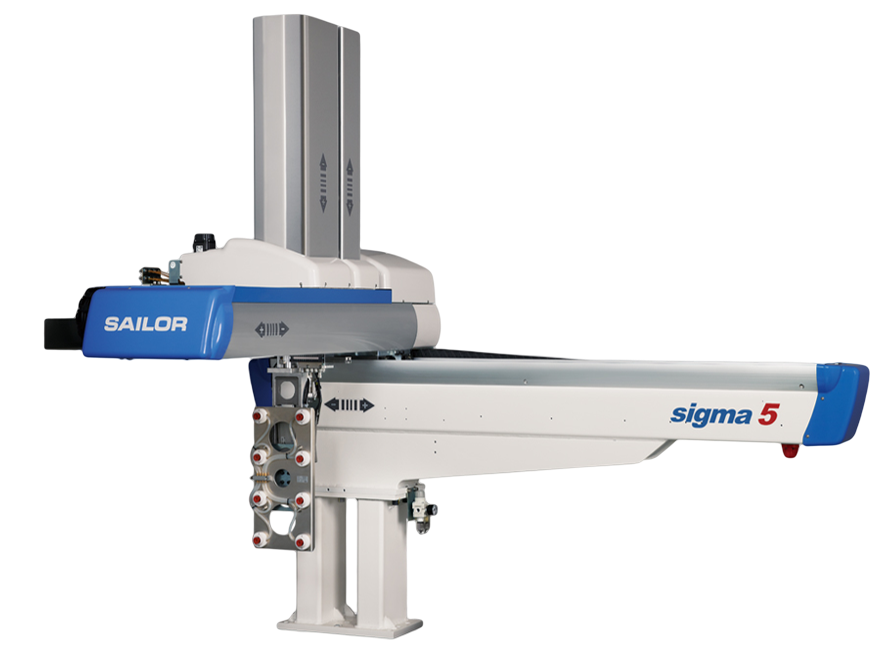
What is a retrieval machine?
A removal machine is a device that automatically removes products molded by an injection molding machine.It operates in conjunction with the molding machine, removing the molded product from the mold and transporting it to its designated location according to the molding cycle.
▼Also recommended
Additionally, during the process of removing and transporting the molded product, related tasks may be performed, such as gate cutting (the process of separating the gate, which is the path for the resin, from the molded product) and insert molding (a method of setting metal parts, etc., into a mold and molding them together with the resin).
▼Also recommended
Structure and operation of the extraction machine
The basic operation of the extraction machine is as follows:
In conjunction with the plastic injection molding machine, once molding is complete and the mold opens, the arm of the removal machine enters the mold, and the molded product is held in place by a chuck (a gripping part that holds the molded product) and removed.
▼Also recommended
Afterward, the molded products are transported to the outside of the molding machine and handed over to a designated location such as a conveyor belt. The movement of the extraction machine's arm may be used to combine multiple processes, such as gate cutting, alignment, boxing, and setting insert parts into the mold.
Structurally, there are various types, including orthogonal coordinate types that perform the above-mentioned movements linearly, multi-joint types that use arms with multiple joints, and types that combine rotational and linear movements. However, the currently dominant type of retrieval machine is the orthogonal coordinate type called traverse, and Sailor Pen's products (with some exceptions) are also of this type.
Is the extraction machine an industrial robot?
Whether Sailor's Sigma5 and SigmaA extraction machines (traverse type) qualify as industrial robots,Let's check this in light of the definition in the law (Article 36, Item 31 of the Industrial Safety and Health Regulations).
Requirement 1. Manipulator
The extraction machine typically has a "chuck" attached to the end of an arm, which is used to grasp the product and remove it from the mold. Chucks can use suction cups for adhesion or mechanically grip with claws, but thisThe arm and chuck are generally considered to be part of a "manipulator" due to their purpose and shape.It can be said.
Requirement 2. Storage device (including variable sequence control device and fixed sequence control device)
The current retrieval machine is,The main unit and controller have a built-in computer (small computer, microcontroller, etc.) that stores the operating program and data for each mold.doing.
The basic program is installed at the factory, but the user can configure the operating order, position, speed, etc., through "teaching".
Requirement 3. Automatically perform manipulator movements such as extension, flexion, vertical movement, horizontal movement, or rotation, or combinations thereof, based on information stored in the memory.
The extraction unit operates according to instructions from the microcontroller mentioned above.Multiple arms can be automatically moved based on stored mold information and teaching information.
Furthermore, when compared with the exclusion conditions (Notification No. 339 of June 28, 1983), the following can be observed:
Exclusion 1. Machines with a rated output of 80W or less for the drive motor.
The smallest motor currently used in Sailor's traverse-type take-out machines is 100W (horizontal shaft motor for 50-ton take-out machines).
Exclusion 2. Machines that perform monotonous repetitions of a fixed sequence control device based on information from a fixed sequence control device.
The program for the retrieval unit can be rewritten, its movements can be freely configured using MyPro (a function that allows users to create their own operation patterns), and its position and operation speed can be set as "teachings," and this is both necessary and possible. Furthermore, the operation involves combining movements in multiple directions, and is different from "monotonous" repetitive movements.
in this way,The current traverse-type extraction machines, "sigma5" and "sigmaA," can be clearly described as "industrial robots."
Are there any extraction devices that are excluded from industrial robotics?
As mentioned above, current traverse-type extractors fall under the category of industrial robots, but are there any "extractors" that are excluded from the definition of "industrial robots"?
Other types of pen retrieval mechanisms offered by Sailor Pen include the "swing-head type" found in the RX-8, the "swing-type" found in the SR, and the custom-made "side-entry type."
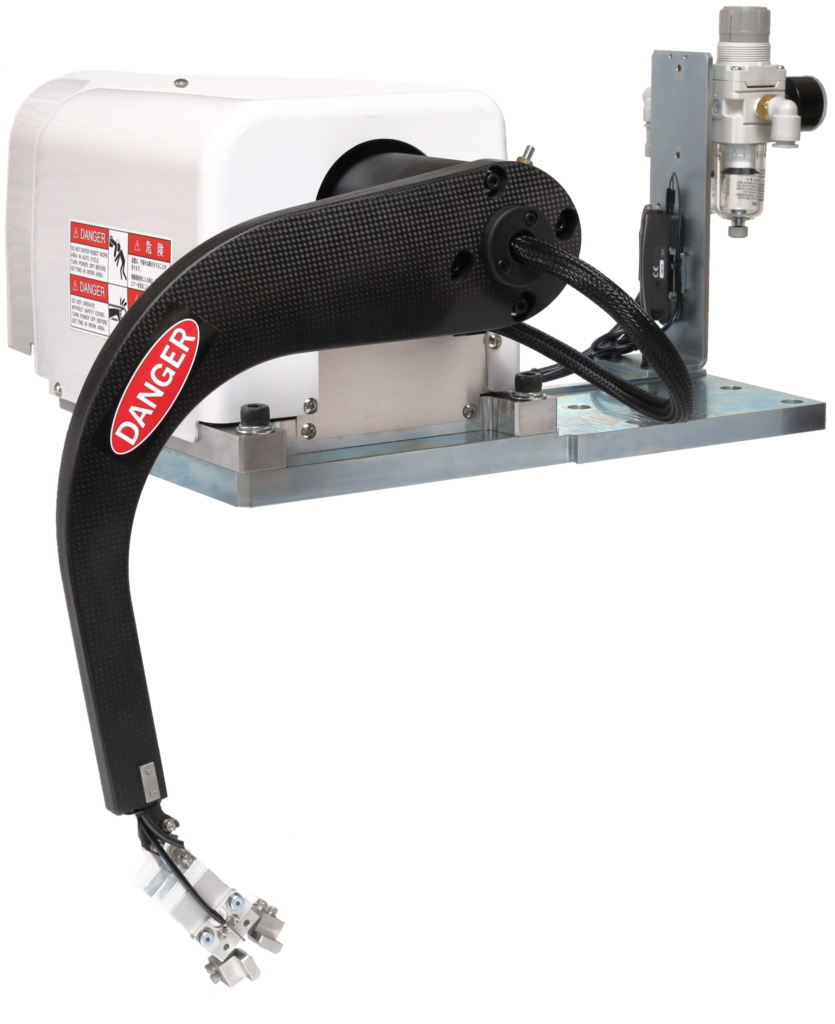
this house,Regarding extraction machines driven by servo motors other than the RX-8, they have multiple servo motor-driven axes, perform complex extraction operations, and require position setting (teaching) using servo functions. Therefore, like the Sigma5 and SigmaA, they fall under the category of "industrial robots." international success.
Swivel-type retrieval machine RX-8
The RX-8 is a extraction device composed solely of air cylinders and does not use a motor.
The purpose of removing molded products from the mold is the same as with traverse-type and other removal machines, but when moving the gripped product from the mold to the outside of the molding machine, it utilizes a rotational (swinging) motion using an air cylinder and crank.
Unlike servo motors, the position of each movement is determined by mechanically pressing the endpoints against a stopper. This position is adjusted by physically changing the position of the stopper using screws or other means.
In this case, since the concept of "teaching" as in servo control does not exist, there is no such thing as "teaching work" as defined as "dangerous or harmful work" in Article 36, Item 31 of the Industrial Safety and Health Regulations. Therefore,In effect, air-driven swivel-type extractors are exempt from regulations for industrial robots.This is how it is interpreted.
*Historically, it seems that this exclusion clause was created to avoid confusion when regulations for industrial robots were established (58), by excluding air-driven swivel-type extractors, which were already widely used, from the scope of industrial robot regulations. In the future, it will be necessary to reconfirm the application of the law to things that did not exist before, such as servo-driven swivel-type extractors.
Summary
As described above,All Sailor fountain pen dispensing machines except for the RX-8 are legally classified as industrial robots and are subject to various legal regulations.Specifically, tasks such as instruction and inspection may require special training, and the installation of safety fences may need to be considered.
Furthermore, even for machines that do not fall under the category of industrial robots under the law, such as the RX-8, it is necessary to consider regulations such as Article 101 (Installation of covers on movable parts, etc.), Article 102 (Stopping operation and lockout during maintenance), and Article 103 (Installation of emergency stop devices) of the Industrial Safety and Health Regulations.
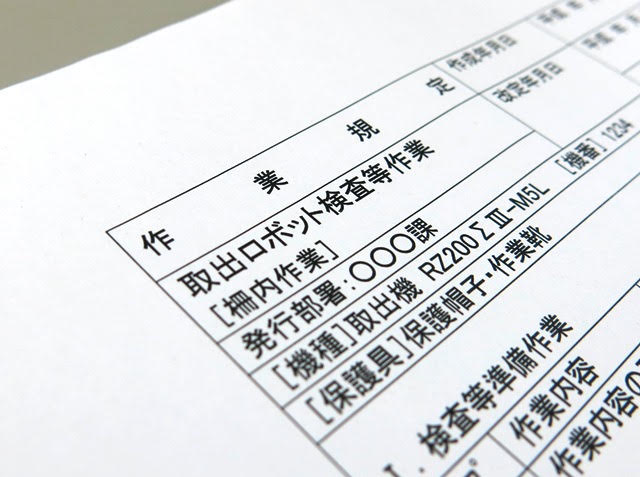
Now, the question, "Is the extraction machine an industrial robot?" implicitly asks whether or not laws and regulations concerning industrial robots should apply, and more honestly, it hides the concern, "Is it necessary to take (or have someone take) special training? (It costs money and time, and we'd rather not do it if possible...)" But if, hypothetically, it is "not an industrial robot" (for example, the RX-8 which is exempt from the aforementioned laws), would safety measures be unnecessary?
The ideal approach to safety measures is not to implement them "because they are mandated by law," but rather "because they are judged to be dangerous." What is needed in this process is a criterion for determining whether something is dangerous or safe, and providing this criterion is what risk assessment is all about.
*Risk assessment (based on ISO 12100) is mandated by the Minister of Health, Labour and Welfare, in accordance with Article 28-2 of the Industrial Safety and Health Act (Investigation of Hazards or Harmful Factors, etc.).It is a matter of best effort as stipulated in the "Guidelines on Comprehensive Safety Standards for Machinery" (Ministry of Health, Labour and Welfare Notification No. 141 of 19).
By conducting a risk assessment of the molding machine and its surroundings, including the extraction machine, and implementing appropriate measures for specific risks that require safety measures, accidents can be prevented.
These risks naturally include obviously dangerous areas and risks during teaching when it's unavoidable to approach the arm while the power is on. However, it's also necessary to consider and implement countermeasures for risks arising from site-specific circumstances, such as the different backgrounds (culture, language, etc.) of workers, their age, gender, and physique.
These are specific circumstances at each site that cannot be fully covered by laws and standards, and should result in effective measures that are far broader in scope than those stipulated by laws and standards, such as "installing fences" and "signing during instruction work," and that are not merely formal.
My honest answer to the first question would be, "Conduct a risk assessment and take appropriate measures if deemed necessary," and "You lack knowledge about the extraction machine and don't understand the risks? Then let's get some special training."
We will discuss "risk assessment" and "appropriate countermeasures" in a separate column.
Sailor Pen's Robotics Division also offers consultations regarding the suitability of retrieval machines for industrial robot applications, as well as safety measures for teaching and inspection operations. Please feel free to contact us if you are considering introducing or replacing a retrieval machine.
Reference:
- Ministry of Health, Labour and Welfare "Industrial Safety and Health Regulations"
- Ministry of Health, Labour and Welfare: "Machinery designated by the Minister of Health, Labour and Welfare pursuant to the provisions of Article 36, Item 31 of the Industrial Safety and Health Regulations"
- Ministry of Health, Labour and Welfare "Practical Manual for the Use of Functional Safety"
- Japanese Standards Association "JIS B 0134:2024 Robotics - Terminology"
- ISO “ISO 8373:2021 Robotics — Vocabulary”
- ISO “ISO 10218-1:2025 Robotics — Safety requirements — Part 1: Industrial robots”
- Ministry of Health, Labour and Welfare, "Partial Amendment to the Enforcement Notice for Article 150-4 of the Industrial Safety and Health Regulations Concerning Industrial Robots (December 24, 2013, Kihatsu 1224 No. 2)"
